
The Epstein War
Congress must pass the War Powers Resolution.

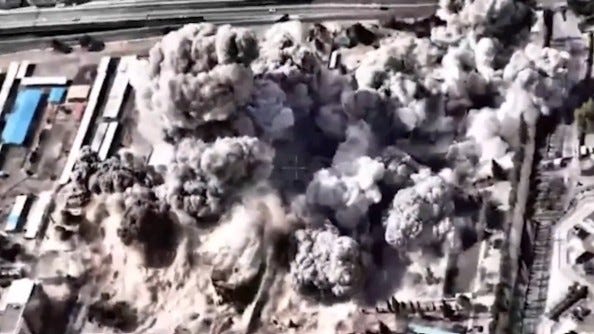
And so the Iran War begins. Actually, a better name would be the Epstein War.
Saturday’s surprise attack on Iran and the killing of Supreme Leader Ayatollah Ali Khamenei is yet again a distraction as President Trump zigs and zags to outrun the Epstein scandal. Yet, try as he might, the Epstein sex trafficking scandal is gaining on him like carnivorous African army ants smelling food.
This is a needless, unprovoked war at a time when the Iranian state poses less risk to the U.S. than it has in decades. It is also a regime change war when this president specifically and repeatedly said he would not pursue foreign entanglements that cost American blood and treasure.
Donald Trump lied to the American people about tackling inflation and he lied to this MAGA base to whom he vowed not to repeat the mistakes of Iraq and Afghanistan. With his singular, unilateral decision to go to war, Trump has escalated his attack on the Constitution and its core principle – the separation of powers.
It has long been understood that in an emergency, democratic leaders can resort to exceptional power because legislatures are too large, unwieldy and slow to respond to a crisis. The doctrine of emergency prerogative, traces back to John Locke’s Second Treatise (1690).
Knowing war is the ultimate power of a king, the founding fathers divided control of war powers. They gave Congress the authority to commence and authorize war, whether that war be declared or undeclared. At the same time, the president was granted the authority to conduct foreign relations and ongoing war as well as the right to respond to sudden attack when Congress was not in session.
Vietnam and the War Powers Act of 1973
The long Cold War era was dominated by the fear of nuclear war with the Soviet Union, setting off an escalation of presidential war-making power. In the Cuban Missile Crisis of 1962, the U.S. faced an emergency threat (the discovery of Soviet missiles in Cuba that could strike Washington DC in minutes) that compelled secrecy and unilateral presidential decision (a blockade of Cuba and secret agreement that the U.S. would remove missiles in Turkey caused the Soviets to back down).
In 1965, President Lyndon Johnson expanded on the war-making powers of the president by intervening first in the Dominican Republic and then, tragically, in Vietnam. He sent 22,000 American troops to the Dominican Republic without congressional approval. His pretext: protecting American lives during a time of unrest. The real reason was to prevent Communists from gaining control of the government; a policy decision that called for congressional participation.
In The Imperial President (1973), historian Arthur M. Schlesinger Jr. wrote: “With the same confidence in exclusive presidential prerogative, Johnson in early 1965 decreed the Americanization of the war in Vietnam, sending American combat units for the first time to the south and American bombers for the first time on a continuing basis to the north … It was a momentous decision – one that brought the United States into a war that lasted longer than any other in American history (until Afghanistan), a war causing more American deaths in combat except the Civil War and the two world wars, a war costing more money than any except the Second World War.”
“‘If this decision was not for Congress under the Constitution, then no decision of any consequence in matters of war and peace is left to Congress,’ wrote Alexander Bickel, a constitutional law scholar at Yale Law School.”
Schlesinger continued: “There were no serious precedents for this decision. Unlike Roosevelt’s Atlantic policy in 1941, Johnson was ordering American troops into immediate and calculated combat. Unlike Truman’s decision in Korea (and George H.W. Bush defending Kuwait against Iraq’s attack), there were no UN resolutions to confer international legality, nor had there been clear-cut invasion across frontiers. Unlike the Cuban missile crisis, there was no emergency threat to the United States itself to compel secret and unilateral presidential decisions. Unlike the Dominican Republic, there were no American civilians to be rescued.” (emphasis added)
Similar to President George W. Bush in the Iraq War, Johnson sought congressional approval. He rushed the infamous Tonkin Gulf resolution through Congress in August 1964 after alleged attacks on American destroyers off the coast of North Vietnam. The vague, broadly worded resolution held that Congress “approves and supports the determination of the President, as Commander in Chief, to take all necessary measures to repel any armed attack against the forces of the United States and to prevent further aggression.” It passed the House unanimously and only two members of the Senate voted against it.
President Johnson did not ask Congress to declare war, instead he merely consulted the “opinion of Congress.” In Johnson’s mind, the role of Congress was not to sanction or declare war, but to support a war the president, and the president alone, had decided to wage.
Johnson saw the Tonkin Gulf resolution as giving him political cover. In his memoir Vantage Point, The Perspectives On The Presidency 1963-1969, LBJ wrote: “Part of being ready, to me, was having the advance support of Congress for anything that might prove to be necessary. It was better to have a firm congressional resolution, and not need it, than some day to need it and not have it.” Johnson used the Tonkin Gulf as proof that Congress had authorized his massive escalation of force in Vietnam.
The disaster of Vietnam caused Congress to pass the War Powers Act of 1973, becoming law when Congress overrode President Nixon’s veto. The act requires the President to consult with the legislature “in every possible instance” before committing troops to war and for the chief executive to notify Congress within 48 hours whenever military forces are introduced “into hostilities or into situations where imminent involvement in hostilities is clearly indicated by the circumstances.” Critically, the War Powers Act also stipulates that presidents are required to end foreign military actions after 60 days unless Congress provides a declaration of war or an authorization for the operation to continue.
Still passage of the War Powers Act did not stop the Vietnam War. That only happened in 1975 when Congress passed the Cooper-Church amendment, cutting off funding over the objections of President Gerald Ford.
In contrast to the current administration, the advisors to President Kennedy and Johnson who guided the nation into a costly and bloody quagmire were among the sharpest foreign policy minds of the era. As detailed in David Halberstam’s The Best and the Brightest, it was hubris, a fear of losing Vietnam to the communists after the loss of Communist China, an underestimation of the capacity of the Vietnamese to take huge losses and still fight, and an expertise on Russia and Europe as opposed to Asia that doomed the effort.
From Iraq to Iran
In 2002, the United States repeated the fiasco of Vietnam, with George W. Bush’s administration using the fear of “weapons of mass destruction” as justification for the invasion and occupation of Saddam Hussein’s Iraq. The WMDs were Bush’s Tonkin Gulf ticket to war and “Jefferson in Baghdad” was the motto conservatives confidently chanted as the United States once again pursued regime change in a part of the world we little understood.
In the end, Iraq was brutalized and another generation of young Americans were fed into a forever war that we could not win. But at least President Bush, Vice President Dick Cheney and Secretary of State Colin Powell presented their case to the public and Congress.
This week Congress will once again attempt to reassert its constitutional authority in matters of war and peace. Reps Ro Khanna (D-CA) and Thomas Massie (R-KY) – the bipartisan duo who forced Congress to pass the law requiring the Department of Justice to release the Epstein files – introduced a War Powers Resolution focused on the possibility of a war with Iran.
Passage of a new War Powers Resolution to reestablish Article 1 constitutional authority is a first step. If that does not curtail the administration’s adventurism, Congress should pass a modern version to the Cooper-Church amendment to cut off funds to an illegal, unconstitutional war.
Iran is a war of choice pursued by an administration stocked full of shocking incompetence. Consider these head-jerking displays of stupidity:
FBI Director Kash Patel just fired the counterterrorism officials in charge of monitoring Iran.
Secretary of State Marco Rubio just fanned the flames of anti-Semitism by saying the U.S. was following Israel’s lead in attacking Iran. Said Senator Mark Warner (D-VA), the vice-chair of the Senate Intelligence committee, “There was no imminent threat to the United States of America by the Iranians. There was a threat to Israel. If we equate a threat to Israel as the equivalent of an imminent threat to the United States, then we are in uncharted territory.”
While Great Britain is able to evacuate its citizens from the Middle East, Americans in 16 Middle East nations are stranded, reports CNN’s Erin Burnett. This is stunning Katrina-level incompetence by a U.S. State Department gutted of professionals by Donald Trump and Marco Rubio.
As North Carolina Republican Senator Thom Tillis said in his blistering performance review of Homeland Security Secretary Kristi Noem’s leadership on Tuesday, the American people have a right to expect a high level of competence by those in charge of the federal government.
Yet, of course, it was Senator Tillis, Senator John Kennedy (LA) and the Senate Republicans who confirmed a cabinet of incompetent Trump-loyalist Instagram windbags. Republican Senators should follow Tillis’ lead and defend the Constitution that they swore an oath to uphold.
Going to war with Iran is idiotic. Congress must assert its authority as a co-equal branch and stop Trump in his tracks.